
Techniques
A multidisciplinary toolkit — cutting-edge recording technologies paired with rigorous computational analysis — for dissecting neural circuits in behaving animals.
In Vivo Electrophysiology
We perform large-scale extracellular recordings using high-density silicon probes (Neuropixels) to monitor the activity of hundreds of neurons simultaneously in behaving animals. This allows us to track neural dynamics across multiple brain regions with millisecond precision.
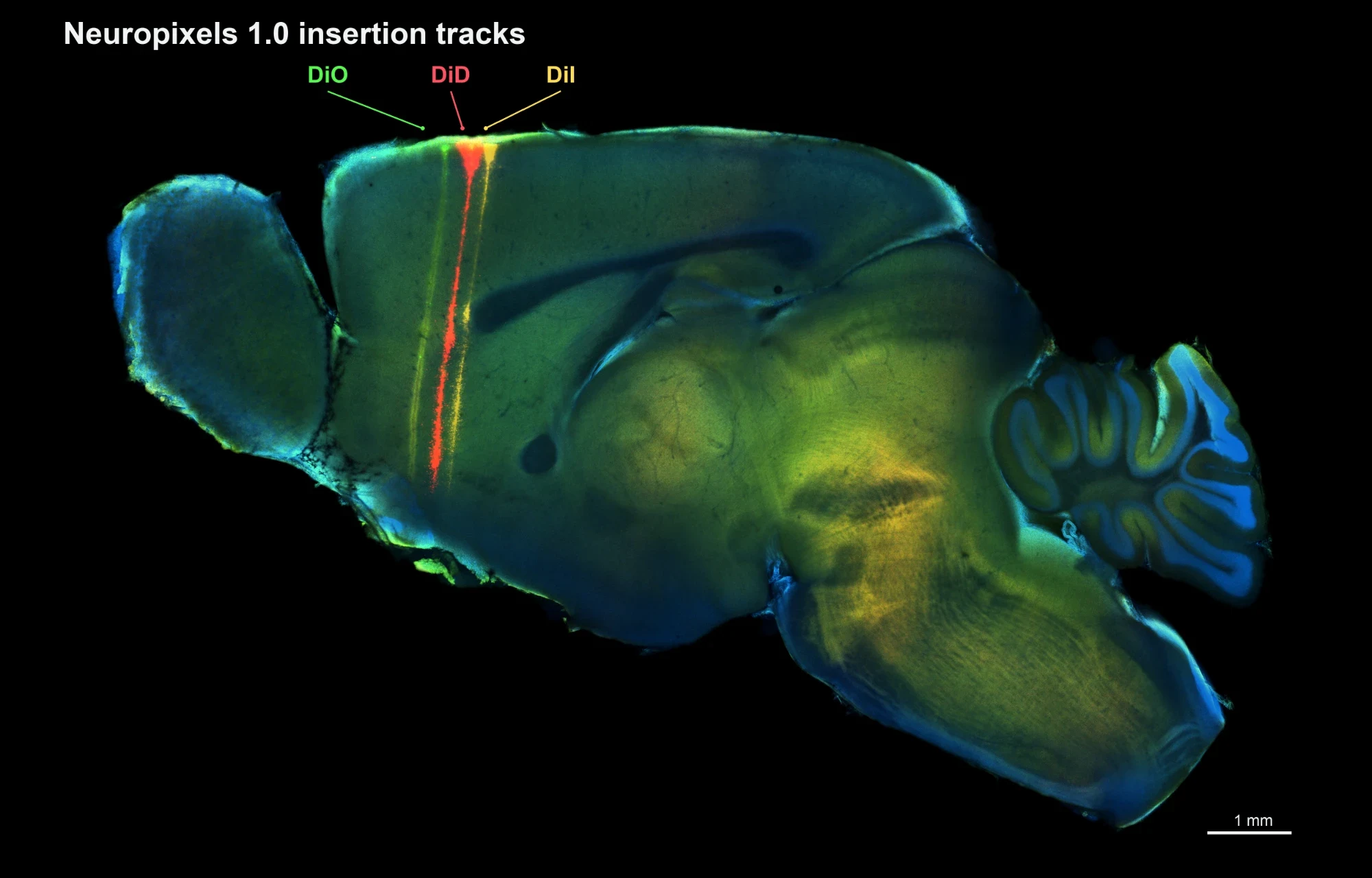
Histological reconstruction of three Neuropixels 1.0 insertions targeting the mouse medial prefrontal cortex. Each probe was coated with a different lipophilic dye (DiO, DiD, DiI) so its track can be identified and aligned to the recorded channels.
Image credit: Esther Lara Gonzalez, PhD
Biosensor Imaging
We use 1-photon and 2-photon imaging to visualize the activity of genetically defined neuronal populations. By expressing fluorescent indicators such as GCaMP, dLight, and GRAB sensors, we can track the activity of specific cell types or neuromodulatory signals during complex behaviors.
Computational Modeling
We develop reinforcement learning agents and neural network models to generate testable hypotheses about neural computation. We compare model behavior and internal representations with experimental data to understand the algorithms implemented by the brain.
Want to learn these techniques?
We welcome motivated researchers who want to develop expertise in these approaches.